
How to Search Harper County Traffic Court Records
Public traffic cases in Harper County are searched through two free Oklahoma court systems. The most useful one is ODCR (On Demand Court Records), which lists Harper County in its court dropdown and carries case types named Traffic Tickets and Declined Traffic Tickets. A declined ticket is a citation the prosecutor chose not to file in court. The state's own OSCN docket search also lists Harper County District Court and accepts a case number when you already have one.
Gather a few details before you start. A citation number or case number gives the fastest match, but a driver name in Last, First order also works. A filed-date range helps when a common name returns several people. Document images are not free to the public on ODCR, so the docket text is what most readers will see online.
- Open ODCR, set the court group to Oklahoma District Courts, then choose Harper.
- Pick the case type Traffic Tickets or Declined Traffic Tickets to filter the results.
- Search by driver name in Last, First order, or enter the full case number if you have it.
- Narrow common names with the filed-date range so the right driver rises to the top.
- Open the case to read the charge, the court date, and the disposition.
Which Courts Handle Traffic Cases in Harper County
Almost every traffic case in Harper County runs through the District Court at the courthouse in Buffalo. The Court Clerk, Susan Breon, keeps those files and collects the fines and costs tied to a ticket. State troopers and the sheriff write citations that land in District Court, and that is where you search, pay, or set a contested case for hearing.
City ordinance tickets are the exception. A municipal court can hear citations written under a town's own code, and that file would not show up in the District Court system. No official Harper County municipal court page was located, so if a ticket was issued by a city officer, confirm the venue with that city before you assume the District Court holds it. For certified copies of a District Court traffic file, the Court Clerk is the office to call.
Harper County Court Clerk / District Court
311 SE 1st St., P.O. Box 347
Buffalo, OK 73834
Phone: 580-735-2010
Fax: 580-735-2787
Hours: Monday to Friday, 8:00 a.m. to 4:00 p.m.
Note: A city traffic ticket and a District Court traffic ticket are separate files, so confirm which court issued the citation before you search or pay.
Types of Traffic Cases on Harper County Records
Traffic records in Harper County cover more than a speeding stop. The Oklahoma case systems sort citations into a handful of groups, and each one shows up under the traffic and criminal filters in ODCR. Knowing the group helps you guess which portal and which fine schedule apply.
- Moving violations - speeding, failure to stop, improper lane changes, and similar driving offenses written as traffic tickets.
- Equipment and non-moving offenses - expired tags, no insurance, and equipment defects that still generate a citation and a fine.
- Declined traffic tickets - citations the district attorney chose not to file, listed separately in ODCR.
- Commercial and CDL violations - tickets against commercial drivers that carry stricter federal reporting rules.
- Alcohol and drug driving offenses - DUI and DWI matters that are filed as criminal cases rather than ordinary traffic tickets.
What Harper County Traffic Court Records Show
A traffic case file in the Oklahoma systems is built from a set of standard fields. The public docket usually shows the citation, the charge, the schedule, and the money owed, even when the scanned image of the ticket itself stays behind an attorney subscription. The table below maps the fields a Harper County traffic record commonly displays.
| Field | What It Shows |
|---|---|
| Citation / Case Number | The ticket number, such as M972124, and the court case number, such as CM-2017-100. |
| Charge / Statute | The offense name and the Oklahoma section cited, plus the offense date. |
| Court Date | The scheduled appearance or arraignment date, and any later continuances. |
| Plea / Disposition | The driver's plea and the case outcome, including a deferred or dismissed result. |
| Fine Amount | The fine assessed for the violation when the case is resolved. |
| Court Costs | The added costs, fees, and any restitution attached to the case. |
| Warrant / Payment-Plan Events | Bench warrant entries, failure-to-appear notes, and a payment-plan number if one exists. |
| Eligibility Message | Whether the balance can be paid online or is not eligible for card payment. |
Searching by Citation Number vs by Name
The fastest search uses the number printed on the ticket. An Oklahoma traffic citation often looks like M972124, while the court case number follows a prefix-year-number pattern such as CM-2017-100. A payment plan, if the court set one up, uses a format like PP-OK-2019-25. Any of these three numbers will land you on the right case in one step.
A name search is the fallback when the ticket is lost. Enter the driver as Last, First and expect more than one match for common names. Watch for typos in the citation number too, since municipal and sheriff citations can use formats that differ from the state pattern. When a name search returns several people, the filed-date range and the offense date will tell the right case apart.
Paying or Contesting a Harper County Traffic Ticket
Eligible District Court balances in Harper County can be paid through OSCN e-Payments. The portal accepts a case number, a citation number, or a payment plan number, and it only shows balances the court has approved for card payment. The e-Payments terms page spells out which counties take online payment. The search screen uses these fields.
| Field Label | Type | Required | Notes / Format |
|---|---|---|---|
| County | Dropdown | Yes | Select a county; Harper is listed. |
| Case, Citation, or Payment Plan Number | Text | Yes | Examples: CM-2017-100, PP-OK-2019-25, M972124. |
| Search | Button | n/a | Searches for eligible payable balances. |
| Back | Button / link | n/a | Returns to the prior step. |
| Look it up | Link | Optional | Routes to the OSCN lookup for users who do not know the number. |
Contesting a ticket is a different path. To enter a not-guilty plea or ask for a hearing, call the Court Clerk before the listed court date and confirm the local steps. Oklahoma plea options run from guilty to no contest to not guilty, and a contested case may require an appearance at the courthouse in Buffalo. The walkthrough below covers both routes.
- Find the citation or case number through ODCR or from your paper ticket.
- Open OSCN e-Payments and select Harper County from the county dropdown.
- Enter the case number, citation number, or payment plan number.
- Review the offense, the balance, and the eligibility message before you pay.
- To contest instead, call the Court Clerk at 580-735-2010 before the court date to confirm your options.
- Keep the receipt or any recall order, then re-check the case for the updated status.
Important: Paying a balance online does not automatically recall a warrant. Confirm with the court that any failure-to-appear or bench warrant has been cleared.
Harper County Court Records vs the Oklahoma Driver Record
Two different files exist for the same ticket, and people often mix them up. The court traffic record is the case the District Court keeps in Harper County. The state driver record, also called a Motor Vehicle Report or MVR, is kept by Service Oklahoma and shows your driving history rather than a single case file. A court fixes a case; the state agency tracks the driving record. The comparison below sets them side by side.
| Aspect | Court Traffic Record | State Driver Record (MVR) |
|---|---|---|
| Record source | District Court or municipal court, kept by the Court Clerk | Service Oklahoma |
| What it shows | Citation, charge, court date, plea, disposition, fines, costs, and warrant or payment-plan events | About three years of driving history, convictions, and license status |
| Where to access | ODCR, OSCN, OSCN e-Payments, or the Court Clerk | The Service Oklahoma MVR portal, by mail, or in person |
| How to correct errors | Contact the Court Clerk or address it in the District Court case | Contact Service Oklahoma; the court disposition must post first |
A look at how the driver record is ordered makes the split clear. The Service Oklahoma Motor Vehicle Report request page opens with a question about whose record you are asking for, which the court file never asks.
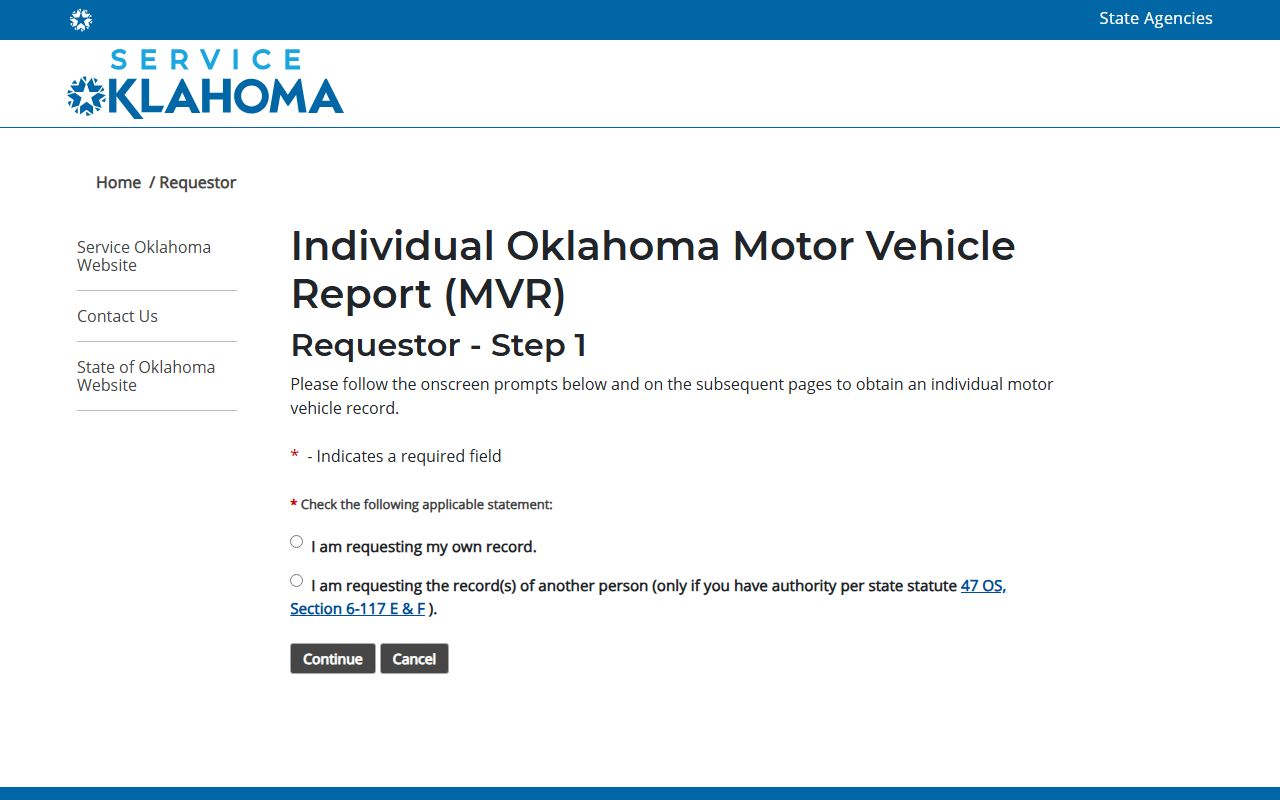
That requestor question controls which version of the record you receive and which fee applies, so it is the first thing a Harper County driver answers when pulling an MVR rather than a court case.
Requesting Your Oklahoma Motor Vehicle Report
A Motor Vehicle Report is the file employers, insurers, and courts mean when they ask for your driving record. Service Oklahoma runs the request and, per its help guide, the MVR shows roughly three years of history. You can order it online, by mail, or in person. The online order can be printed right away as a PDF, and the email link stays open for thirty days.
The agency's help center walks through each channel and the fees. The Service Oklahoma MVR help article explains the mail address and online delivery for a driving record.
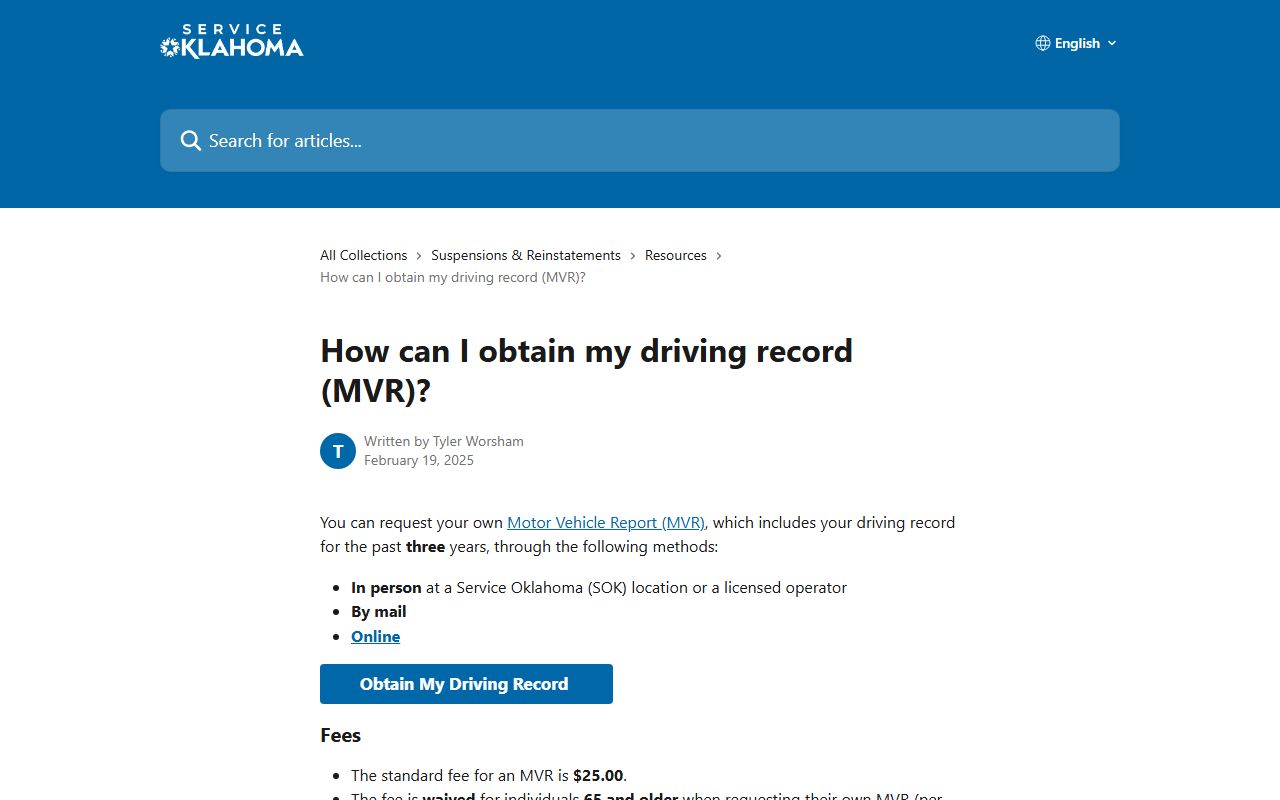
That guide is worth reading first because the MVR is the record that reflects how a Harper County traffic case affected your license, while the court docket only reports the case itself. A standard MVR costs $25, a certified copy adds three dollars for $28, and drivers age 65 or older may get their own record free under 47 O.S. Section 6-117(D).
Note: A traffic conviction has to post to the court record before it can move to your state driving record, so the two files can disagree for a short time after a case closes.
Harper County Collision Reports
A crash report is its own record, apart from both the traffic court file and the driver record. Service Oklahoma handles collision report requests on a paper form, and the report can take up to thirty days to populate after a wreck. The fee is $7 for a copy or $10 for a certified copy, paid through the form's listed methods.
The state keeps the collision request form and related crash materials on one page. The Oklahoma DPS forms page carries the traffic collision report materials and request instructions.
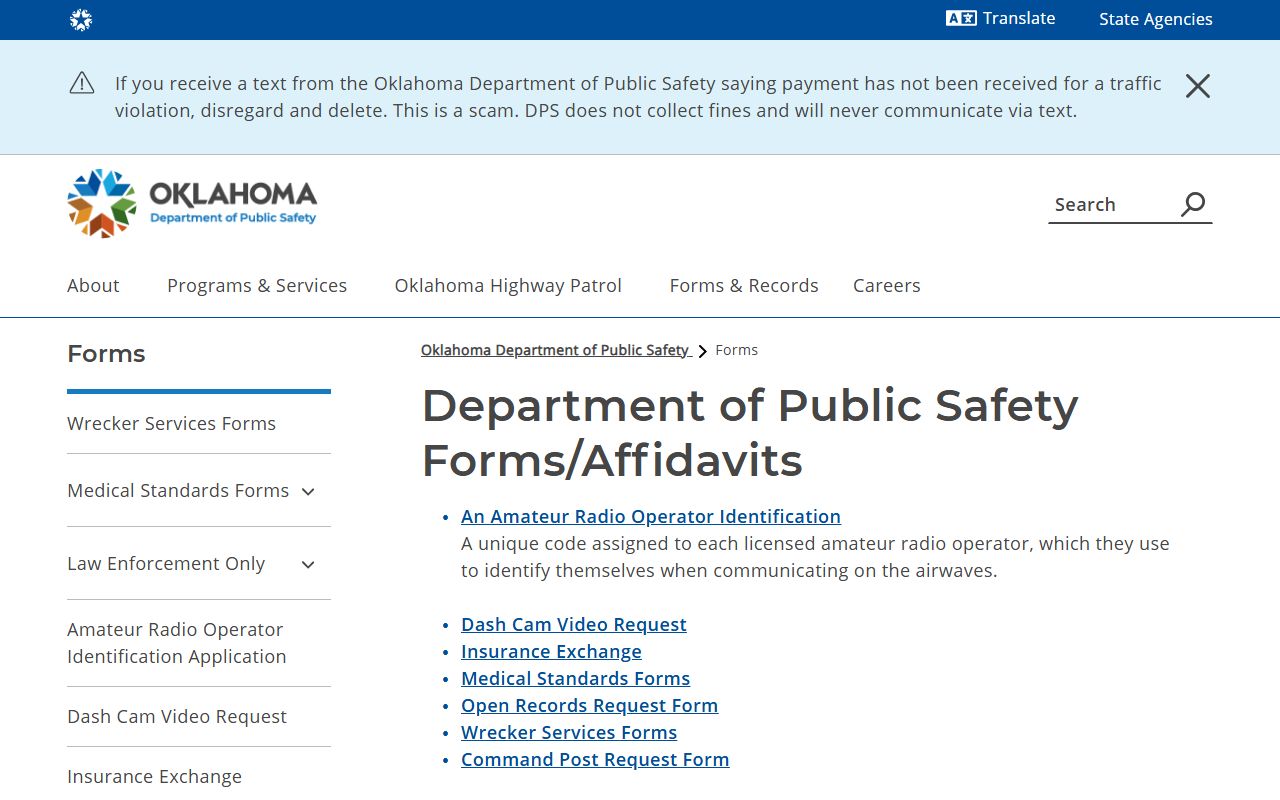
For a driver in a Harper County crash, that forms page is the right starting point because the collision report sits outside the District Court case and is not searched in ODCR or OSCN.
Public Access Laws for Harper County Traffic Records
Traffic court files are public records in Oklahoma unless a statute or a judge closes them. The Oklahoma Open Records Act backs general access to court and government records, and the online dockets are offered as a public convenience. Driver record data carries its own privacy layer, since the state limits who may pull another person's MVR. The statutes below frame what is open and what is restricted.
Key Statutes:
51 O.S. Section 24A.1 et seq. - the Oklahoma Open Records Act makes public records generally open unless a specific law makes them confidential.
OCCA Rule 2.6 - the online OSCN case search is a public convenience, and the court's official record controls if the two ever disagree.
47 O.S. Section 6-117 - sets the privacy and disclosure rules that govern who may obtain a driver's Motor Vehicle Report.
Note: Sealed, expunged, and juvenile traffic matters are not general public records, so a portal search will not return a case a court has ordered closed.
DUI and DWI Cases
Drunk and drugged driving cases are not ordinary traffic tickets. In Oklahoma a DUI or DWI is charged as a criminal matter, usually a misdemeanor or felony, and it carries a full criminal case file rather than a simple citation balance. That file holds the arrest, the charges, any bond, the plea, and the sentence.
For the full Harper County DUI and DWI case file, including charges and disposition, see the Harper County criminal court records. The traffic portals still show the case, but the criminal record carries the detail that matters most.
CDL and Driver Privacy Caveats
Commercial drivers face stricter rules. A CDL holder cited for a moving violation often cannot resolve it the same casual way a regular driver might, because federal reporting requires many commercial violations to reach the driving record. That can affect a livelihood, so a CDL driver should weigh a court appearance and legal advice before paying a ticket outright.
Privacy law also limits who can read a driver record. Under the state disclosure rules, another person's MVR is released only to requestors with a lawful reason and proper authority, such as a government agency, an insurer, an employer of a CDL holder, or someone with the driver's written consent. The court docket is public, but the driving record behind it is guarded.
Deferred Sentences and Defensive Driving
Oklahoma courts can hand down a deferred sentence, an outcome where the judge holds off on a final judgment while the driver meets conditions. A deferred result can keep a conviction off the record if the conditions are met, and the docket will note the deferral and its terms. Eligibility depends on the offense and the driver's history.
A defensive driving or driver-improvement course is sometimes offered to keep a ticket from counting against a record, but no Harper County-specific course program was confirmed in the official sources reviewed. Before assuming a class is an option, ask the Court Clerk at 580-735-2010 whether the court allows it and how to enroll. Do not rely on a private vendor's promise without that confirmation.
- Deferred sentence
- An outcome where the court delays final judgment while the driver completes set conditions.
- Disposition
- The recorded outcome of the case, such as guilty, dismissed, or deferred.
- Declined ticket
- A citation the district attorney chose not to file, listed separately in ODCR.
Sealing or Expunging Harper County Traffic Records
Some traffic-related court records can be sealed once a person qualifies. Oklahoma expungement law lists who may seek to seal a record and how the process runs. A request is filed in the District Court through the Court Clerk, affected agencies receive notice, and a judge decides whether the record should be closed to public view.
Sealing is not instant erasure. Even after an order, the agencies that hold the record need the order and time to process it, so a portal may still show a case briefly. Harper County-specific expungement fees were not located in the official sources reviewed, so confirm any cost with the Court Clerk before filing.
Fees for Harper County Traffic Records
The clearest fees on a Harper County traffic matter are the state record fees, since Service Oklahoma sets them. The court itself charges for certified copies of a case file, but a Harper County-specific copy fee schedule was not located in the official sources reviewed, so confirm those amounts with the Court Clerk. The state record fees below are documented.
| Item | Amount |
|---|---|
| Motor Vehicle Report, standard | $25 |
| Motor Vehicle Report, certified | $28 |
| Motor Vehicle Report, age 65+ own record | No charge |
| Collision report copy | $7 |
| Collision report, certified | $10 |
For a certified copy of a District Court traffic case, contact the Harper County Court Clerk to confirm the per-page charge and accepted payment methods before you visit or mail a request.